10 Of The Best Lower Ab Exercises
Your lower abs are one of the trickiest areas to target. Here are 10 moves we love and how to train them so you feel it in the right place.

January 8, 2025 - Updated September 2, 2026
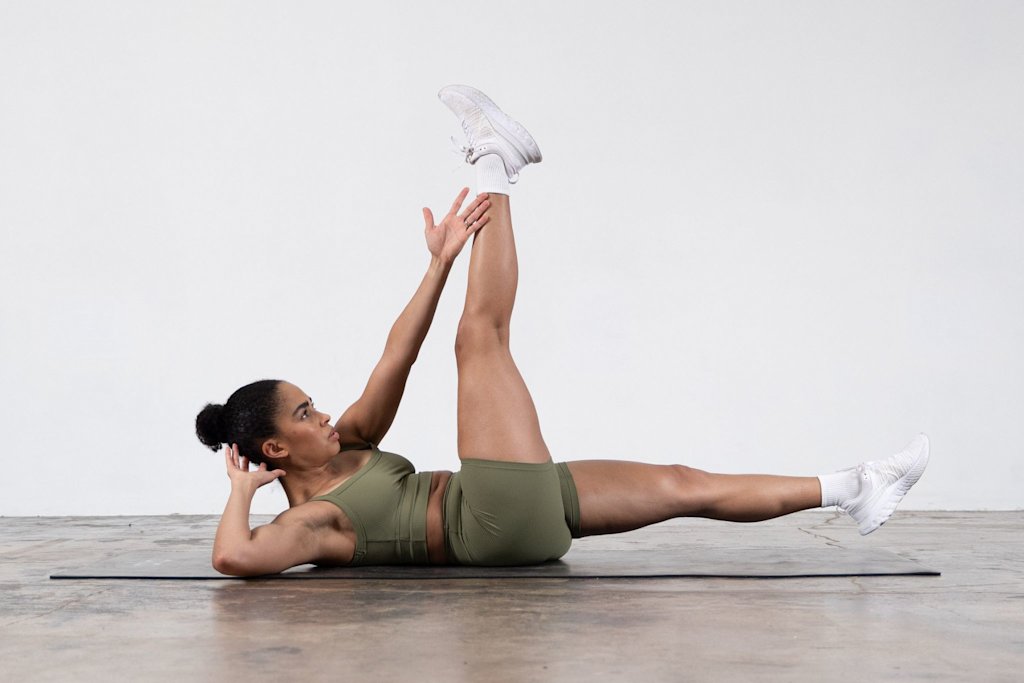
With any ab workout, it’s common to feel that intense burn, but then realise you're only feeling it in the upper section of your core. The lower area around feels like it's doing absolutely nothing.
We hear this frustration a lot, and much of it is because classic ab exercises (like crunches) move your shoulders toward your hips, which loads the top of your core and leaves the bottom doing very little. If you want the lower half to work, it's not that you're not engaging it; it's that you need to train it differently.
Below are 10 of the best lower ab exercises, plus how to tell whether you're actually working your abs or just your hip flexors.
Can you actually target your lower abs?
Sort of. Basically, your rectus abdominis (the muscle people mean when they say "abs") is one long sheet running from your ribs down to your pubic bone. There's not some separate lower ab muscle you're trying to isolate. What you can do is bias more of the work toward the lower section.
The evidence here is mixed but useful. Some studies find the rectus abdominis fires fairly evenly as one unit. Others show meaningful regional differences depending on the movement. Research published in Physical Therapy found the reverse crunch on a 30-degree incline produced the highest activity in the lower portion of the muscle of all the exercises tested. A 2024 ultrasound study also found recruitment tends to be biased toward where the load is: crunches loaded the upper segment more, leg-driven movements shifted the work down.
It can help to think of it like this:
If your legs are moving toward your torso, you'll feel it lower.
If your shoulders are moving toward your hips, you'll feel it higher.
Most people already do plenty of the second and almost none of the first.
You also can't spot reduce fat from your lower stomach, and no amount of leg raises will change that. Body composition changes need a sustainable calorie deficit achieved through a balance of movement and good nutrition. But you can definitely build strength there, and that's what these exercises are for.
Why lower ab strength is worth training
A strong core, top to bottom and side to side, supports your mobility, stability, posture, spinal health and how easily you move through your day.
When part of your core is weak, other muscles pick up the slack. That usually means your lower back and hip flexors working harder than they should during heavy lifts, running, or something as ordinary as lifting a toddler out of a car seat. Over time, that's where aches and niggles start.
One study of 74 adults found core endurance was linked to better performance across push-ups, jumping, sprinting and strength tests. Core strength shows up everywhere, which is why it's worth building, even if aesthetics aren't your goal.
10 of the best lower ab exercises
These are ordered roughly from the most lower-ab dominant down. You don't need to do all 10 in one session; just pick three or four.
One form cue that applies to every mat exercise here: keep your lower back pressed flat into the mat. On leg raises especially, only lower your legs as far as you can while your back stays glued down. The moment it starts to arch, bring them back up. Range of motion is not the goal; keeping the tension in your abs is, and that tension moves from your abs to your lower back as soon as your back arches.
Leg raises
The most direct lower ab exercise there is, and the one where form matters most. If you feel it in your lower back, you've gone too low.
Lie on your back on a yoga mat. Extend both legs straight up in the air and engage your abdominal muscles by drawing your belly button in towards your spine or thinking about pressing your back flat against the floor. This is your starting position.
While keeping your legs extended, slowly lower your legs towards the mat, as far as they’ll go with your back staying flat on the mat. If you can lower them all the way down, stop just above the floor without touching your heels to the mat.
Slowly raise your legs to return to the starting position. Repeat.
Hip lifts
This exercise add a small posterior pelvic tilt at the top, which is exactly the action the lower fibers are best at. Think about lifting your hips off the mat, not just your feet.
Start by lying straight on your back on the floor and place both hands underneath your coccyx bone. Extend both legs and engage your abdominal muscles by drawing in your belly button to your spine. This is your starting position.
Keeping your feet together, slowly raise your legs off of the floor until they form a 90-degree angle with your hips.
Allow your hips and lower back to lift off of the floor and press your feet upwards towards the ceiling.
Slowly lower your legs to return to the starting position. Repeat.
Flutter kicks
Low load, high time under tension. These are great as a core finisher.
Start by lying on your back on a yoga mat. Engage your abdominal muscles by drawing your belly button in towards your spine and raise both legs off the floor. This is your starting position.
Lift both feet off the floor by a couple of inches, then start to make small alternating flutter kick motions with your feet, never letting your feet touch the floor.
Continue alternating between right and left.
Scissor kicks
Same idea as flutter kicks, just with a bigger range, so you get a little more hip flexor stretch and a lot more burn.
Start by lying flat on your back on a yoga mat with your arms by your sides and palms on the floor. Imprint your spine into the mat, then lift your head and shoulders off the mat.
Lift your left leg up towards the ceiling, then swap your legs, lowering your left leg down to the mat as you lift your right leg up.
Continue alternating between right and left in a scissor motion, keeping your heels off the mat at all times if you can.
Jackknives
One of the few moves that loads the top and bottom of your core at once, since your shoulders and legs lift together.
Lie on your back on a yoga mat. Extend both legs and engage your abdominal muscles by drawing your belly button in towards your spine. This is your starting position.
While keeping your legs extended, slowly raise your legs upwards until they form a 90-degree angle with your hips. At the same time, bring your arms forward and upward towards your feet, slowly lifting your head, shoulder blades and torso off the mat.
Slowly lower your arms and legs to return to the starting position, but without lowering your feet fully to the floor. Repeat.
Hanging bent-leg raises
Gravity does the loading for you here, and hanging takes your lower back out of the equation. When you've mastered bent-leg raises, challenge yourself with straight-leg raises.
Hold onto a bar, rings or chin-up machine handles and let your body hang. This is your starting position.
Using your abdominals, bend your knees and bring them in towards your chest.
Extend your knees to return to the starting position. Repeat.
Dead bugs
The anti-extension move. Your job with this one is to keep your core steady and stop your back from arching while your limbs move.
Lie on your back on a yoga mat with your arms extended up towards the ceiling and palms facing toward your feet. Bend your knees and bring your legs into a tabletop position, ensuring that your knees are stacked over your hips, and your shins are parallel to the floor. This is your starting position.
Gently draw your belly button towards ribs to engage your core.
Draw your left arm back and down toward the floor, alongside your head. At the same time, extend your right knee and hip to lower your right leg towards the floor.
Raise your left arm and right leg to return to the starting position.
Draw your right arm back and down towards the floor, alongside your head. At the same time, extend your left knee and hip to lower your left leg towards the floor. Once again, ensure that your arm and leg are lowering at the same speed and that you maintain a neutral spine.
Raise your right arm and left leg to return to the starting position. Continue alternating between left and right.
Hollow hold
An isometric hold that teaches you what proper core bracing feels like. Bend your knees more if you need to make it easier.
Start by lying flat on your back on a yoga mat. Bend your knees and elevate your legs into tabletop position, ensuring that your shins are parallel to (in line with) the floor. Brace your abdominals by drawing your belly button in towards your spine. This is your starting position.
Extend your arms above your head and extend your knees so that your legs are angled to approximately 45-degrees - forming an arc or boat shape with your body. Elevate your legs more to reduce the difficulty or lower your legs more to increase the difficulty.
Hold this position for 30-60 seconds or as long as you can, breathing deeply throughout and ensuring that you keep your abdominals braced to prevent discomfort in your lower back.
Hundreds
A Pilates classic that builds core endurance rather than raw strength. Lower your legs closer to the floor to make it even harder.
Start by lying flat on your back on a yoga mat. Bend your knees and position your feet firmly on the mat. Imprint your spine into the mat and bring your legs into tabletop position, ensuring that your knees are stacked over your hips, your toes are pointed, and your shins are parallel to the floor. Rest your hands gently on your knees. This is your starting position.
Tuck your chin into your chest as you gently draw your ribs to your hips to engage your core. Then elevate your head by raising your shoulder blades and upper back off the mat, ensuring that your core remains engaged to prevent the ‘doming’ of your abdominals. At the same time, extend your arms by your sides with palms facing down, ensuring that your arms are parallel to the floor.
Pulse your arms up and down - just a couple of inches per pulse - counting five pulses as you inhale and five pulses as you exhale.
Continue pulsing for 100 pulses if you can!
30 SECS
Mountain climbers
Less lower-ab specific than the rest, but a great way to train core stability and get your heart rate up.
Place both hands on your yoga mat shoulder-width apart with both feet together behind you, resting on the balls of your feet. Gently draw your ribs to your hips to engage your core. This is your starting position.
Keeping your left foot on the floor, bend your right knee and bring it in towards your chest.
Extend your right leg to return to the starting position.
Keeping your right foot on the floor, bend your left knee and bring it in towards your chest.
Extend your left leg to return to the starting position. Continue alternating between right and left, picking it up to a running pace if you can.
How often should you train your lower abs?
This depends far more on what your training already looks like than on any magic number of workouts.
For example, if you're following a Pilates program, you'll train your lower abs in almost every session, often without a dedicated ab block. Much of what you're already doing in Pilates is core work.
If you're following a strength program, check your workout split. Many Sweat programs already build core work into the weekly schedule, so check yours before you add more on top. It's also important to remember that just because you're not doing an "ab exercise" doesn't mean you're not working your core. Compound lifts like squats, deadlifts, and overhead presses demand a lot from your core to keep your torso stable under load. They all build core strength too.
If your program is light on core work, or you want to give your lower abs some focused attention, two to three short sessions a week is plenty. Five to 10 minutes each.
A simple place to start:
Pick three or four exercises from the list above
12 to 20 reps each, or 30 to 45 seconds for the holds and kicks
Two to three rounds
Focus on form and really feeling it in your core instead of focusing on range or speed
Your abs are muscles like any other, which means they respond to progressive overload, but they need recovery to rebuild. Daily ab workouts are not the answer.
How do you know if it's working your abs or your hip flexors?
This is the question not enough people talk about, and it's why leg raises feel wrong for so many people.
Every leg-driven ab exercise also recruits your hip flexors, particularly the psoas, which runs from your lower spine to your thigh. That's normal, but it becomes a problem when your hip flexors take over completely and your lower back arches to compensate.
Signs your hip flexors are running the show:
Your lower back lifts off the mat
You feel a pinch or ache at the front of your hips
Your back is sore afterwards, but your abs aren't
What to do about it:
Shorten the range of each rep. Lower your legs only as far as your back stays flat
Bend your knees. Bent-leg versions shorten the lever and reduce hip flexor demand
Tuck your pelvis slightly, as though you're tilting your hip bones toward your ribs, before you start
Exhale as you lower
Once you can hold that position under control and are feeling it in your core, start extending the range again.
What to do if your stomach cones or domes
If you notice a ridge or bulge running down the center of your stomach during an ab exercise, that's coning or doming. It's a sign the load is more than your deep core can manage right now, and it's especially common during pregnancy and postpartum.
Cleveland Clinic advises avoiding movements that push the abdominals outward, including crunches, sit-ups, double leg lifts and scissors, until you can perform them without that bulge appearing.
If that's you, dead bugs and modified planks are usually a better starting point than leg raises, and pelvic floor work matters as much as the ab work. We've covered this properly in our guide to diastasis recti and postpartum exercise, and it's worth speaking to a pelvic health physio before you jump back into loaded core training.
How long does it take to get visible abs?
If you've been training consistently, feel strong through your core, and still can't see anything, nothing has gone wrong. Ab strength and ab visibility are two very different things.
Visible abs come down to body fat percentage, and where you store body fat is largely genetic. For most people, seeing definition requires a sustained calorie deficit alongside consistent training.
Improving your body composition can be a meaningful goal; we'd just never recommend using visible abs as your measure of progress or success, because it's the metric you have the least control over and it's also doesn't reflect your strength or fitness. There are far better ways to track how you're going.
Stronger core, stronger you
Lower abs aren't a separate muscle, but they are an area most training plans underwork. Move your legs toward your torso, keep your back flat, stop when your form goes, and train them two or three times a week rather than daily.
Start with leg raises, hip lifts and flutter kicks. There are also heaps of ab workouts in the Sweat app and structured programs designed to build your core strength.
Erin is a writer and editor at Sweat with years of experience in women's publishing, the fitness industry, media and tech. She's passionate about the power of movement, and you can often find her on a yoga mat, a hike, a dance floor, in the ocean or the gym.
* Disclaimer: This blog post is not intended to replace the advice of a medical professional. The above information should not be used to diagnose, treat, or prevent any disease or medical condition. Please consult your doctor before making any changes to your diet, sleep methods, daily activity, or fitness routine. Sweat assumes no responsibility for any personal injury or damage sustained by any recommendations, opinions, or advice given in this article.
Fitness