Side Stitch Stopping You Mid-Run? Here's How To Make It Go Away
Sharp pain under your ribs mid-workout? Here's how to ease a side stitch in a few minutes, and what makes it less likely next time.

August 9, 2021 - Updated November 5, 2026
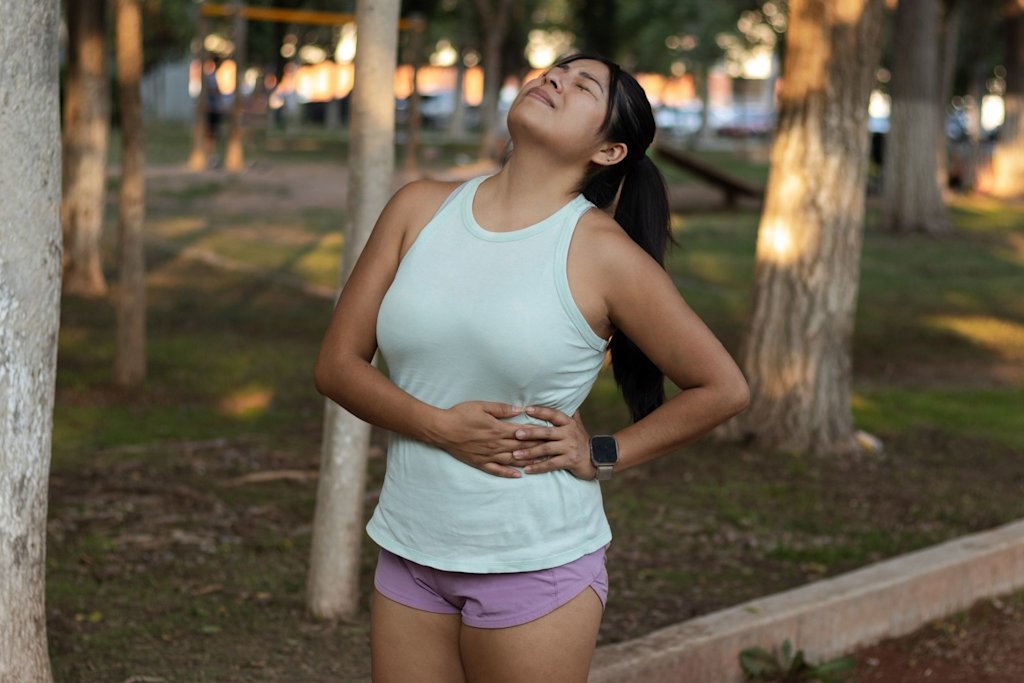
You're 10 minutes into a run, you've finally found your rhythm, and a sharp pain jabs in just under your ribs. That's a side stitch. If you've got the grit to keep running through it and don't want to slow down, that's your call, but the quickest way to ease it is to slow to a walk, press your fingers firmly into the sore spot, and breathe out slowly and deeply while you bend forward slightly. For most people, it fades within a few minutes.
Stitches are common and harmless. In a survey of 965 athletes, 61% had had one in the past year (Morton & Callister, 2015). And for most people, what you eat and drink in the two hours before you train matters more than any core exercise, which is good news, because that's an easy thing to change.
What is a side stitch?
A side stitch is a sharp, stabbing or cramping pain on one side of your abdomen, usually just below your ribs. Researchers call it exercise-related transient abdominal pain (ETAP), and transient is the key word: it comes on during exercise and settles once you ease off.
It's most common in activities that jolt or twist your torso over and over, like running, swimming, horse riding and jumping workouts. Stitches are more common in younger people and tend to happen less as we get older. And if you think they go away when you get fitter, that's not necessarily how it works. Fitness level and body type don't seem to make much difference.
Some people also feel a sharp pain at the tip of the shoulder at the same time. That can feel alarming, but it's a recognized part of a stitch.
What causes a side stitch? (Probably not your breathing)
Nobody knows for certain, but the leading theory is irritation of the lining of your abdominal wall. This lining has two thin layers. When your stomach is full and your torso is bouncing or twisting, the layers can rub against each other, and that friction may trigger the pain (Morton & Callister, 2015).
You'll often read that a stitch is a cramp in your diaphragm (the dome-shaped muscle under your lungs that helps you breathe), but that idea has fallen out of favor. Horse riders get stitches even though their breathing isn't working hard, and studies haven't found breathing changes in people with a stitch. Slow, deep breathing can still help ease the pain, though, and we'll explain how below.
A stitch is more likely if you:
Eat a large meal or drink a lot of fluid in the two hours before you exercise
Drink sugary, concentrated drinks like fruit juice beforehand
Do a lot of bouncing or twisting, like running or jumping
Train with a rounded, slouched upper back (Morton & Callister, 2010)
There's also the idea that side stitches are caused by dehydration, but the research points more to drinking too much fluid at once as the culprit, especially sugary fluid. Small, regular sips of water throughout the day are the way to go.

How to get rid of a side stitch mid-workout
You don't need to end your workout. Slow down, then work through these until the pain eases:
Slow down. Drop to a walk or an easy pace. If the pain hasn't settled after a minute or two, stop and stand still.
Press into the pain. Push your fingertips firmly into the sore spot and hold them there.
Breathe slowly and deeply. Focus on breathing into your belly rather than your chest, then breathe out for longer than you breathed in, through pursed lips (like blowing out through a straw).
Bend forward. Keep your fingers pressed in and hinge forward from your hips, letting your upper body fold slightly towards your thighs. Many people find this combination works fastest.
Stretch the sore side. Stand tall, reach the arm on the sore side up overhead and lean gently away from it, so you feel a stretch along that side of your waist. Hold for a few breaths.
If you're running, some runners find it helps to change which foot lands as they breathe out. With a stitch on your right side, try breathing out as your left foot hits the ground. It won't work for everyone and can be a bit of a mission to coordinate, but it's worth a try if nothing is working!
Once the pain has gone, ease back into your pace over a few minutes rather than rushing straight back into your previous pace.
How to stop side stitches coming back
Most of the prevention comes down to timing. Here's what you might want to experiment with if regular stitches are messing with your runs or workouts:
Give food time to settle. Leave around two hours after a full meal before you train. If you're working out first thing or squeezing a run into a lunch break, keep it light: half a banana or a slice of toast is plenty. If you get stitches on lunch-break runs, try moving lunch to after your run and having a small snack mid-morning for some fuel.
Sip, don't gulp. Small sips of water before and during exercise are better than downing a full bottle at the start. And if you're going to drink juice or sugary drinks, save them til after.
Warm up properly. Spend 5 to 10 minutes warming up, including some dynamic stretches that twist, reach and arch through your torso.
Stand tall. When you run or walk, keep your chest lifted and shoulders relaxed rather than hunched forward. Glute bridges and back extensions can help your posture over time.
Build up gradually. Stitches often show up when you're new to running or coming back after a break. Add time or pace a little at a time instead of starting fast.
Strengthen your core. A 2014 study of 50 runners linked stronger core muscles with fewer stitches. Planks and learning to engage your core are a simple place to start.
A stronger core may help, but don't expect a core routine to fix stitches on its own. For most people, the bigger wins are what and when you eat and drink, and running regularly enough that your body gets used to it. They're all simple tweaks - nothing that requires a special program.
When side pain might not be a stitch
A stitch should ease within minutes of slowing down and be gone soon after you stop. Pain in your side that won't go away, or that comes on when you're not exercising, isn't a stitch and is always worth getting checked.
See your doctor if you have:
Side or abdominal pain that lasts for hours after exercise, or happens at rest
Pain that's severe, getting worse, or low on the right side of your abdomen
Pain with fever, nausea, vomiting, swelling or blood in your urine or stool
Call emergency services if side pain comes with chest pain, shortness of breath that doesn't settle, or pain spreading to your arm, neck or jaw.
Simple fixes are your best bet
When a stitch hits, slow down, press into it, breathe out slowly and bend forward. It should pass within a few minutes.
If you keep getting them, look at your pre-workout routine first. A big lunch, a large glass of juice or a fast start are the usual culprits, and they're all easy to change. If side pain doesn't fit the pattern of a stitch, trust that and get it checked!
A more empowered you starts with Sweat, and our editorial team is here to bring you the latest fitness tips, trainer recommendations, wellbeing news, nutritional advice, nourishing recipes and free workouts.
* Disclaimer: This blog post is not intended to replace the advice of a medical professional. The above information should not be used to diagnose, treat, or prevent any disease or medical condition. Please consult your doctor before making any changes to your diet, sleep methods, daily activity, or fitness routine. Sweat assumes no responsibility for any personal injury or damage sustained by any recommendations, opinions, or advice given in this article.
Fitness